

Tendon Injuries in Horses
The reason for these common injury patterns is the significant load that the tendons and suspensory ligament are subjected to – often close to the limit of what is possible for biological tissues to withstand. Furthermore, these structures are relatively unprotected, in a part of the legs that lacks muscles and other buffering soft tissue.
The vulnerability of the lower limbs is a price the horse pays for their extreme specialization and high-performance function. Thanks to their slender construction and long, elastic tendons, the horse can develop explosive power in its flight – which in turn has guaranteed survival and has made the horse successful.
The Tendon Apparatus – Tendons and Ligaments for Elasticity and Stability
The horse's flexor tendons (DDFT, the deep digital flexor tendon, and SDFT, the superficial digital flexor tendon) combine strength with elasticity. They consist of resilient connective tissue fibers that, in turn, are made from the proteins collagen and elastin. These tendons run between the horse's powerful muscles and the skeleton in the pastern bone, coffin bone, or pedal bone.
The construction in its entirety is surrounded by ligaments – connective tissue structures that stabilize and maintain the skeleton's configuration as well as hold together the complex joints.
The suspensory ligament on the other hand is originally neither one nor the other. Instead, it is a modified muscle that exhibits higher elasticity than a tendon.
It is usually one of these described structures that is involved when a horse suffers a tendon injury.
Preventing and Detecting Tendon Injuries
Tendon injuries are very common in horses and can also be difficult to heal. The tendon apparatus can be damaged by both internal and external factors: on the one hand tendons can be overstressed by heavy or incorrect loading – on the other hand they can be exposed to external violence, for example during strikes or blows to the legs.
But the connective tissue cells of the tendons are also temperature-sensitive. When the horse works, the springy tendons store large amounts of kinetic energy, which increases their internal temperature – something that can lead to damaging overheating.
Tendon injuries are also the most common cause of lameness in horses. The best thing a horse owner can do, of course, is to prevent them; work that must continue throughout the horse's life - with the help of balanced training, thoughtful nutrition and appropriate protection for the exposed structures.
Equally important is to give the horse's lower legs great care and constant attention, checking them frequently to detect abnormalities at an early stage - for example, swelling or heat build-up. Always consult a veterinarian if the horse seems to be in pain or if an injury has occurred.
Even mild symptoms, if not detected in time, can develop into inflammations and injuries which, in the worst case, may require both long-term rest and care.
Early detection of even subtle tendon injuries is crucial because:
- Continuing to work a horse with a tendon injury can worsen the damage and lead to a more serious and prolonged recovery.
- Early intervention and appropriate management (rest, controlled exercise) can improve the prognosis for healing.
Detecting Tendon Injuries Without Lameness:
Detecting tendon injuries in horses without obvious lameness can be challenging as horses, especially those with stoic temperaments or mild injuries, may not always present with significant lameness. However, there are several subtle signs that can help identify these issues:
- Mild or intermittent lameness: The horse might show a very slight change in gait, a shortened stride, that quickly disappears with rest or during warm-up. This can be easily missed.
- Heat: Carefully palpate the tendons (especially the superficial and deep flexor tendons) and compare the temperature to the same area on the opposite leg. Increased heat indicates inflammation.
- Swelling or thickening: Run your hands along the tendons, feeling for any subtle enlargement, thickening, or changes in the normal contour. This might be easier to detect when comparing both legs.
- Pain on palpation: Gently apply pressure along the length of the tendons. A horse with a tendon injury might show a reaction, such as flinching, moving away, or increased tension in the leg.
- Reduced performance: A subtle decrease in performance, reluctance to perform certain movements, or changes in stride length or cadence can indicate underlying musculoskeletal pain, including tendon injuries. This might be more noticeable to the rider.
- Changes in hoof placement: In some cases of subtle tendon injury, the horse might slightly alter how they place their hooves to offload the affected area.
- Increased filling or distension of tendon sheaths: Inflammation inside the tendon sheath (the fluid-filled structure surrounding some tendons) can cause a noticeable filling or windgalls, even without significant lameness.
Tendon Injuries With Lameness:
It is always important for a veterinarian to examine a lame horse to make a correct diagnosis and determine the cause of the lameness. Self-diagnosis can lead to incorrect treatment and prolonged healing time. If you suspect a tendon injury, a veterinary examination, including ultrasound, is necessary to identify and determine the cause of the lameness.
A veterinarian performs a detailed lameness evaluation, including palpation of the legs, observation of the horse's movements at walk, trot, and sometimes canter, as well as performing flexion tests. Even if obvious lameness is not present, subtle abnormalities can be detected.
Ultrasound examination is the standard method for diagnosing soft tissue injuries such as tendon injuries. Ultrasound allows the veterinarian to visualize the tendon fibers, identify ruptures, inflammation, and assess the extent of the injury.
It is often recommended to perform an ultrasound examination approximately one week after a suspected injury, as the changes in the tendon become clearer as inflammation develops.
In summary, you can know that lameness is due to a tendon injury if:
- The horse shows lameness that worsens with weight-bearing on the affected leg. There are clinical signs of inflammation (heat, swelling, tenderness) that are specifically localized to one or more tendons.
- The ultrasound examination confirms damage to the tendon.
- The lameness improves or disappears when the area around the tendon is anesthetized with a nerve block, while other potential sources of pain are ruled out.
What to Do for an Acute Tendon Injury:
In the case of a confirmed tendon injury in a horse, the goal is to reduce inflammation, pain, promote healing, and restore tendon function. Treatment and rehabilitation is a long process that requires patience and accuracy. Here are the most important steps and measures:
Acute phase (the first 48-72 hours):
- Rest: Immediate and strict stall rest is crucial to prevent further damage.
- Cold therapy: Cool the injured area with cold water (10-15 minutes, 3-4 times a day) or cold bandages to reduce inflammation and swelling.
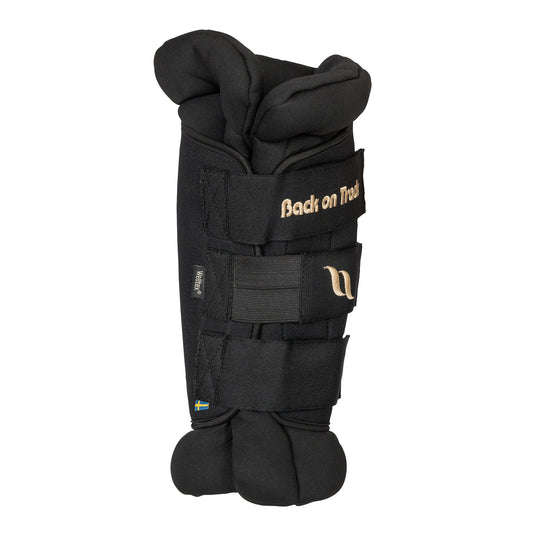
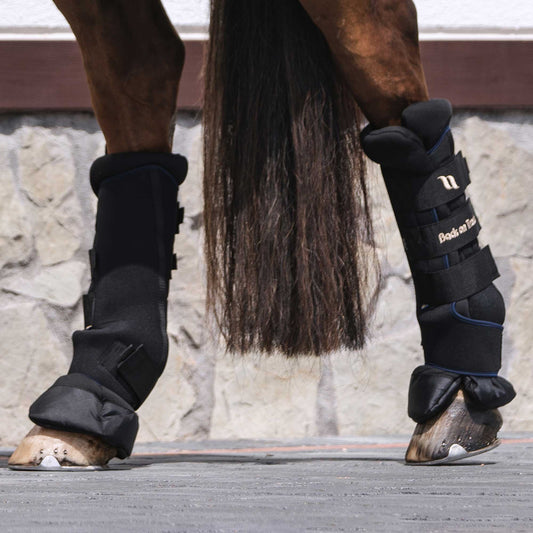
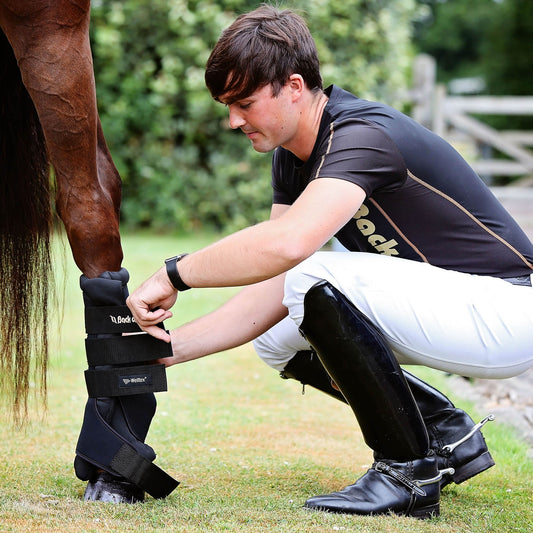
- Bandaging: Apply a supportive but not too tight bandage to reduce swelling and provide light support.
- Veterinary contact: Always contact a veterinarian as soon as possible for a correct diagnosis and treatment plan.
- Pain relief and anti-inflammatory medication: The veterinarian may prescribe painkillers and non-steroidal anti-inflammatory drugs (NSAIDs) to reduce pain and inflammation.
Further treatment depends on the extent of the injury:
- Continued rest: Rest remains central during the healing process.
- Controlled movement: Once the acute inflammation has subsided, the veterinarian may gradually introduce controlled walking exercise on hard, even ground. This promotes blood circulation and organized tendon healing.
In some cases, the veterinarian may recommend medical treatments:
Injections into the tendon:
- PRP (Platelet Rich Plasma), stem cells, or hyaluronic acid can be injected into the tendon to stimulate healing.
- Shockwave therapy: Can be used to stimulate blood flow and healing.
- Laser therapy: Some studies suggest that laser can have a positive effect on tendon healing.
Rehabilitation is usually a slow and gradual process:
- Increased walking exercise:
- Gradually increase the time and distance of walking exercise according to the veterinarian's instructions.
- Introduction of trot: Once the tendon has healed sufficiently, short periods of slow trot on a straight track are introduced.
- Gradual increase in load: Training is increased very slowly and controlled, with regular veterinary check-ups and follow-up ultrasound examinations to ensure that the tendon heals properly and is not overloaded.
- Return to work: Return to full work is gradual and can take anywhere from six months to over a year, depending on the extent of the injury. Relapses are common if you progress too quickly.
- Core training and stabilizing exercises: Can help improve the horse's biomechanics and reduce the risk of new injuries.
- Water therapy: Can be a gentle way to build strength and fitness during rehabilitation.
A successful return to full work after a tendon injury requires a dedicated team consisting of the horse owner, veterinarian, farrier, and possibly other specialists such as a physiotherapist or equine therapist.
You might like
-

 Outlet
 -

 Outlet
 -
Royal Deluxe Staldbandage
Normalpris 889,00 DKKNormalpris -
Staldbandage Royal
Normalpris 768,00 DKKNormalpris



Related posts
-

Melting coolness
Cold, heavy stone – could that be any good? Yes, sometimes this can be the most soothing thing you can place on your forehead, neck and shoulders – or on...
Melting coolness
Cold, heavy stone – could that be any good? Yes, sometimes this can be the most soothing thing you can place on your forehead, neck and shoulders – or on...
-

Cool on Track - Comfort cooling in hot temperat...
Discover Cool on Track - our summer heat saviour! Have you heard of Cool on Track - our summer heat saviour? Cool on Track is a range of products made...
Cool on Track - Comfort cooling in hot temperat...
Discover Cool on Track - our summer heat saviour! Have you heard of Cool on Track - our summer heat saviour? Cool on Track is a range of products made...
-

Besök 60plusmässan i Uppsala!
Take the opportunity to visit the 60plus fair at Fyrishov in Uppsala! On 18-19 March, our retailer Vobis Livskvalitet will be there to showcase its range and explain how its...
Besök 60plusmässan i Uppsala!
Take the opportunity to visit the 60plus fair at Fyrishov in Uppsala! On 18-19 March, our retailer Vobis Livskvalitet will be there to showcase its range and explain how its...


